Person in the Tomb
Merkez Efendi (real name Musa, patronymic Abü’t-Taki, title Merkez Muslihuddin) was born around 1463–64 in the village of Sarı Mahmudlu in Denizli.
After receiving his early education there, he moved to Bursa in 1478, where he studied in madrasas for about 15 years. In 1493, he settled in Istanbul and studied under Ahmed Pasha in particular.
He turned to Sufism and became affiliated with the Halveti and Sunbuli orders, receiving his spiritual authorization (khilafah) from Sunbul Efendi and becoming a prominent figure of the order.
He gave sermons at Hagia Sophia and taught tafsir and hadith. He contributed to the spread of the order by building tekkes, zawiyas, and mosques in Istanbul and Manisa. • He had close ties with Sultan Suleiman the Magnificent during the latter’s tenure as governor of Manisa, and accompanied him as a spiritual guide on the Corfu campaign. His tekke in Eyüp is named after him.
It is rumored that he married Şah Sultan and had sons named Ahmed Çelebi, Derviş Çelebi, and Ali Çelebi, as well as a daughter named Ümmü Hatun; his children held both religious and state positions.
He established significant endowments including a mosque, school, and retreat cell in his native village, Hafsa Sultan Complex in Manisa, and his own tekke in Mevlanakapı, Istanbul. His funeral prayer was led by Şeyhülislâm Ebüssuûd Efendi. It is said he had more than 500 disciples. Though he left no written works, hymns under the pen name “Merkezî” are known.
About the Mausoleum
- Year Built
- Commissioned By
- Architect
- Location
Featured Highlights
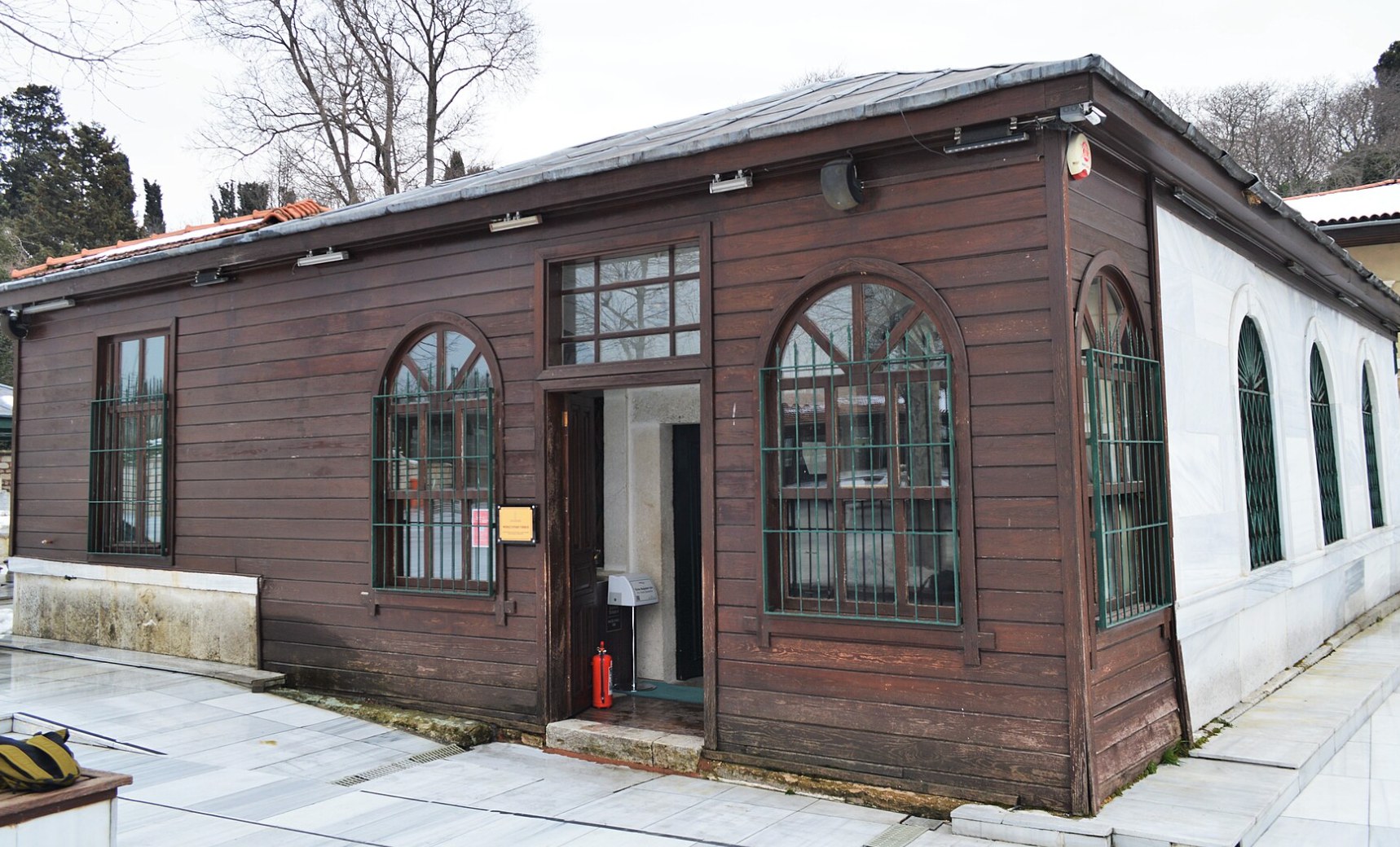
The current structure was renovated by Sultan Mahmud II; there is no definitive information on the original construction date. The renewed tomb initially consisted of two rectangular sections: one housing Merkez Efendi’s sarcophagus and the other containing the graves of tekke sheikhs and their families.
The tomb is built of rubble stone and brick, and features Empire-style architecture with a square plan.
The western facade is covered in marble; the main dome is internally coated with bağdadi plaster and externally with lead. The 1836 addition is topped with a hipped roof. Three round-arched windows with keystones adorn the western facade.
The walls are covered up to the dome base with 19th-century European tiles. Inside the dome is a starry decoration and a calligraphic inscription by M. Şevket Vahdeti.
Merkez Efendi’s sarcophagus is surrounded by a wooden railing in 18th-century style, inlaid with mother-of-pearl and tortoiseshell. In front of it, a plaque written in Ottoman Turkish by calligrapher Aziz Efendi praises Merkez Efendi with mystical references, describing him as the light, the truth, and the center of the cosmos, emphasizing his spiritual greatness.