Changes After Construction
In the first centuries after its foundation, the institution provided education in different buildings around the Patriarchate; in 1804 it moved to the Mavrokordatos Mansion in Kuruçeşme, and in 1850 to the Hacı Hanannon House opposite the Patriarchate in Fener.
In the competition held for the present monumental building, the project of the school’s graduate Konstantinos Dimadis was selected.
The foundation excavation of the building began in 1875; because of financial difficulties, the foundation-laying ceremony was held on 30 January 1880.
The present building was constructed between 1880 and 1882 and was opened for use on 12 September 1882.
In the construction records, the transport of materials by sea, porterage, cart, and fine workmanship payments are listed as separate items; this shows that the building was completed through a large-scale and multi-stage construction organization.
A gymnasium was built in the school garden in 1904; this structure was later demolished.
In 1903, a department focused on classical philology and pedagogy for training primary school teachers was added to the school; this phase was a period in which the educational function of the building was expanded within the institution.
In 1912, special alterations were made to the building for the installation of a Foucault pendulum produced by Max Kohl.
In the Republican period, the school continued under the name Fener Greek Boys’ High School; in 1989, with the admission of female students, the students in the adjacent Yuvakimion building were moved to the main building, and today the institution continues to operate under the name Private Fener Greek Secondary School and High School.
Featured Highlights
It was known by the names Red School and Red Schoolhouse.
The foundation of the school dates to 1454; the foundation took place within the framework of Mehmed the Conqueror’s decree regarding the ability of the Orthodox to receive education in their own language and the agreement made with Patriarch Gennadios.
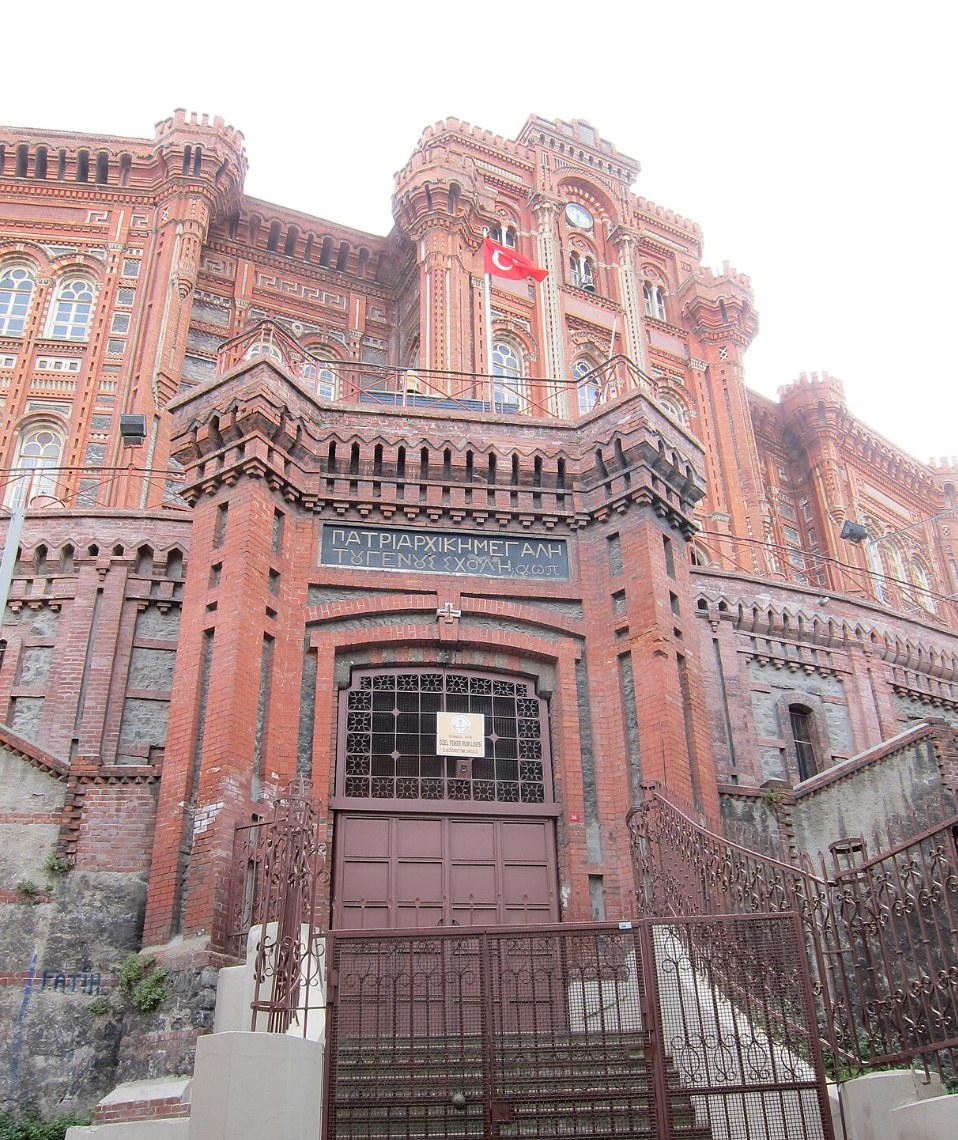
The magnificent building that survives today was constructed on a commanding hill on the slopes of Fener.
It was described as the largest structure after Süleymaniye among the buildings on the two shores of the Golden Horn.
The building is distinguished by its broad and high facade, its red fire bricks, and the thick domed tower at its centre.
In the records concerning the construction process, it is stated that Albanian, Croatian, Muslim, and Greek masters worked together, and that an Armenian named Haco appears as the head labourer.
In its architectural language, the Byzantine influence is strong through keramoplastic decoration, polychromy, stepped arches, and the motifs on the roof crown; in addition, Roman, Gothic, Venetian Renaissance, and Central European influences are seen together.
Most of the building materials were brought from Marseille.
On the ceiling of the ceremonial room on the second floor, there are frescoes including ancient philosophers and figures associated with the Orthodox educational tradition; these features show that the building carries representational value beyond being an educational structure.
The Foucault pendulum dated 1912 is thought to be the first pendulum in the Ottoman Empire.
In the Ottoman period, the school was described as an institution that trained chief dragomans, the rulers of Wallachia and Moldavia, and patriarchs and high-ranking clergy.
The Zigomalas family (father and son), Theophilos Korydaleus, Alexandros Mavrokordatos, Eugenios Voulgaris, and Konstantin Kumas were counted among the teachers of the school.
Because of its size, the building was at times confused with the Greek Orthodox Patriarchate of Fener.