Changes After Construction
Sahakyan School was founded in 1461 in the courtyard of the Surp Kevork Patriarchal Church by Patriarch Hovagim, who was declared the Patriarch of the Ottoman Armenians by decree of Mehmed II, six years after the Conquest of Istanbul.
After the permission granted to the Ottoman Armenians to open schools by the decree of Sultan Selim III in 1789, Sahakyan School continued to operate as an educational institution serving male students.
In 1831, the Nunyan Girls’ School was opened within Sahakyan.
In the fire of 1866, the school buildings were completely destroyed.
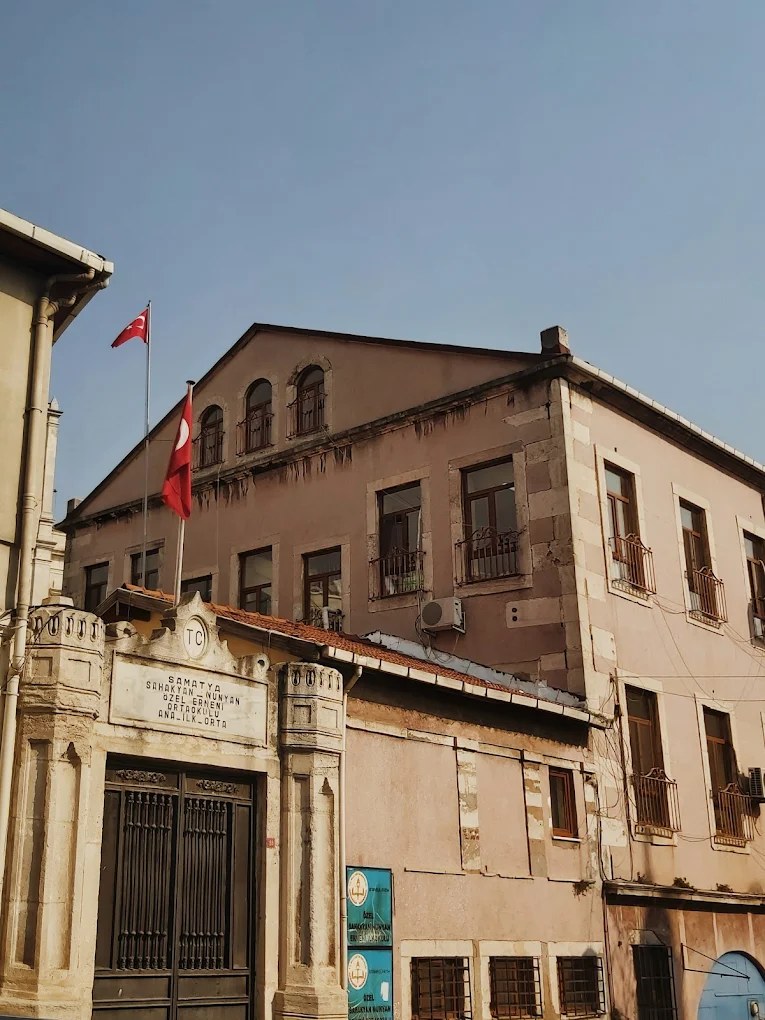
In 1872, the girls’ school building, previously wooden, was rebuilt in stone by Kasbar Haçaduryan, and with the addition of his wife’s name, the school was named Nunyan-Vartuhyan.
Shortly after these repairs, the school building attended by male students was also rebuilt in stone by Mikael Kasbar Haçaduryan, son of Kasbar Haçaduryan, and made ready for education.
Between 1915 and 1918, the school buildings were used for military purposes.
After the war, as one of the school buildings was used for accommodation until 1923, education was suspended; after 1923, the school resumed operation.
Sahakyan and Nunyan-Vartuhyan schools continued education as two separate buildings within the church courtyard; over time, they were transformed into the co-educational Sahakyan-Nunyan Primary School and continued to operate.
In 1960, the secondary school was opened, and in 1966, the high school was opened.
Featured Highlights
The building is also known by the names “Sahakyan School” and “Nunyan-Vartuhyan.”
Sahakyan School is one of the oldest educational institutions in Istanbul and is recognized as the first school of the Armenian community in the city.
Education within the campus was carried out in two separate school buildings within the same courtyard.
The campus is part of a group of structures associated with the Surp Kevork Church.