
Featured Highlights
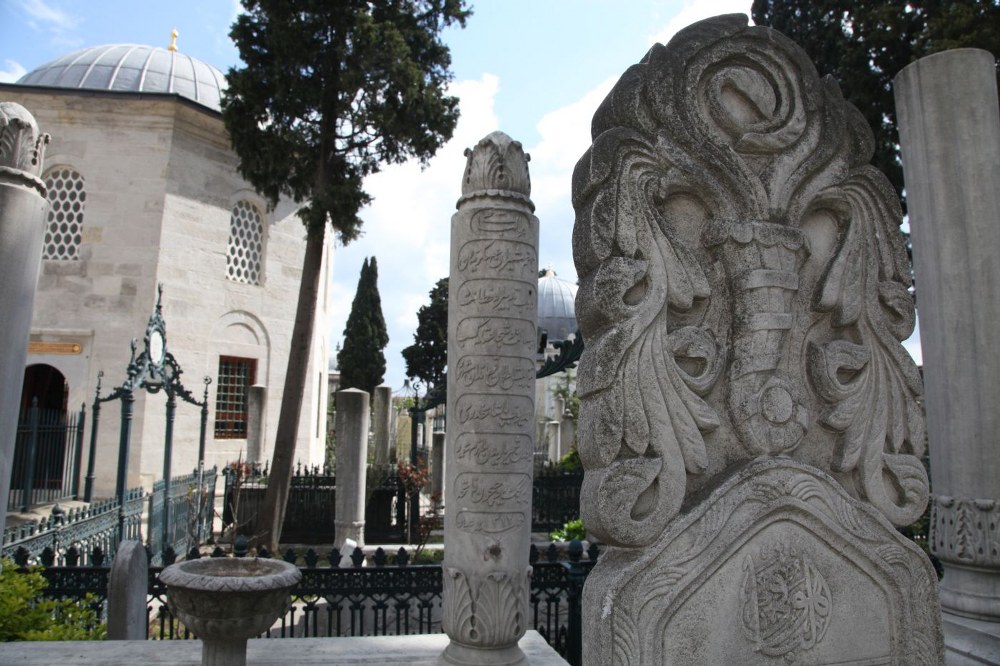
Cemeteries known as hazires are private burial grounds located around külliyes, mosques, tekkes or small mosques, generally on the qibla side. With the gravestones they contain, these cemeteries function as open-air museums that shed light on history. Alongside brief information about the lives of those buried here, the gravestones themselves are important historical documents. Each is also a work of art, preserving the memory of the poets, calligraphers, stone carvers and aesthetic taste of its period.
With the completion of the Fatih Mosque Complex in 1470, the area first became home to the tombs of Mehmed the Conqueror and his wife Gülbahar Hatun. For nearly the first three centuries, it was closed to the burial of civilians and state officials, and was used only for members of the dynasty and very exceptional figures from the palace circle.
The mosque and its surroundings were heavily damaged in the great Istanbul earthquake of 1766. When Sultan Mustafa III rebuilt the mosque, the cemetery area was also reorganized. Its transformation into a dense burial ground for civil and official figures gained momentum after 1780, corresponding to 1194 in the Hijri calendar. With the construction of the Nakşidil Sultan Tomb in 1817, the boundaries of the cemetery became more clearly defined and were enclosed by walls.
In 1871, the burial of Şeyhülislam Mehmed Refik Efendi here by imperial decree gave the cemetery the character of an “open-air museum” where scholars, military figures and intellectuals gathered in death. After this date, major historical figures such as Ahmed Cevdet Paşa, Gazi Osman Paşa and Ali Emirî Efendi were also buried here.
After the proclamation of the Republic, burials in the cemetery were prohibited under the law that closed tekkes, zawiyas and tombs.
Today, burial in the cemetery is possible only with the approval of the President and a decision of the Council of Ministers, now the Presidential Cabinet. In this way, figures of recent history such as Prof. Dr. Halil İnalcık, Prof. Dr. Kemal Karpat and Kadir Topbaş have been accepted into this historic burial ground.
Although there are 409 gravestones in the Fatih Mosque Cemetery, the number reaches 425 when the numbered grave markers thought to belong to empty graves are included. The owners of 47 graves could not be identified. Of the identified gravestones, 113 belong to women and 177 to men.
Today, many historical figures buried in the Fatih Mosque Cemetery await their visitors, among them Gazi Osman Paşa, Şeyhülislam Mehmed Refik Efendi, Ahmed Midhat Efendi, Ahmed Cevdet Paşa, Şehbenderzâde Filibeli Ahmed Hilmi, Calligrapher Sami Efendi, Gazi Ahmed Muhtar Paşa, Ali Emirî Efendi, Mehmed Esad Yesârî, Yesârîzâde Mustafa İzzet, Salih Zeki Bey, Bolâhenk Nuri Bey, Âbidin Paşa, Ahmed Amîş Efendi and many others.
Information on the cemetery numbers and names of the persons buried in the Fatih Mosque Cemetery has been arranged according to the 2007 work **“Türk Kültür ve Medeniyet Tarihinde Fatih Külliyesi”** by Fevzi Günüç and Ali Rıza Özcan, prepared by İstanbul Büyükşehir Belediyesi Kültür A.Ş.