
Adem Bey
Profile summary
Highlights
Âdem Bey, whose date of birth has not been identified, belonged to a family of Albanian origin and served as supervisor in the Adana Central Directorate of the Régie. The Régie Administration was a semi-official body concerned with the administration and supervision of tobacco revenues in the Ottoman Empire; in regions important for tobacco production and trade, such as Adana, it had a wide administrative and supervisory organization.
Âdem Bey’s service in Adana can be traced from the late 1880s to the second half of the 1890s. He was decorated for his success in office, while his wife Cebire Hanım was awarded the Şefkat Order, Second Class, for the aid she provided for military needs.
Âdem Bey was the son-in-law of Âbidin Paşa, one of the late Ottoman statesmen. Prevezeli Âbidin Paşa served as governor of Adana, Sivas, Ankara, Salonica and the Province of the Aegean Islands, briefly served as Minister of Foreign Affairs, and was also known for his translation and commentary of the Mesnevî. Âdem Bey’s kinship with Âbidin Paşa was considered important enough to be especially emphasized on his gravestone.
Âdem Bey’s family continued to be remembered in later years within the circle of Âbidin Paşa. A mevlid announcement from 1930 mentions Feriha Hanım, the granddaughter of Âbidin Paşa and daughter of Âdem Bey. This Feriha Hanım was the wife of the writer Ercümend Ekrem Talû, son of Recaizâde Mahmud Ekrem.
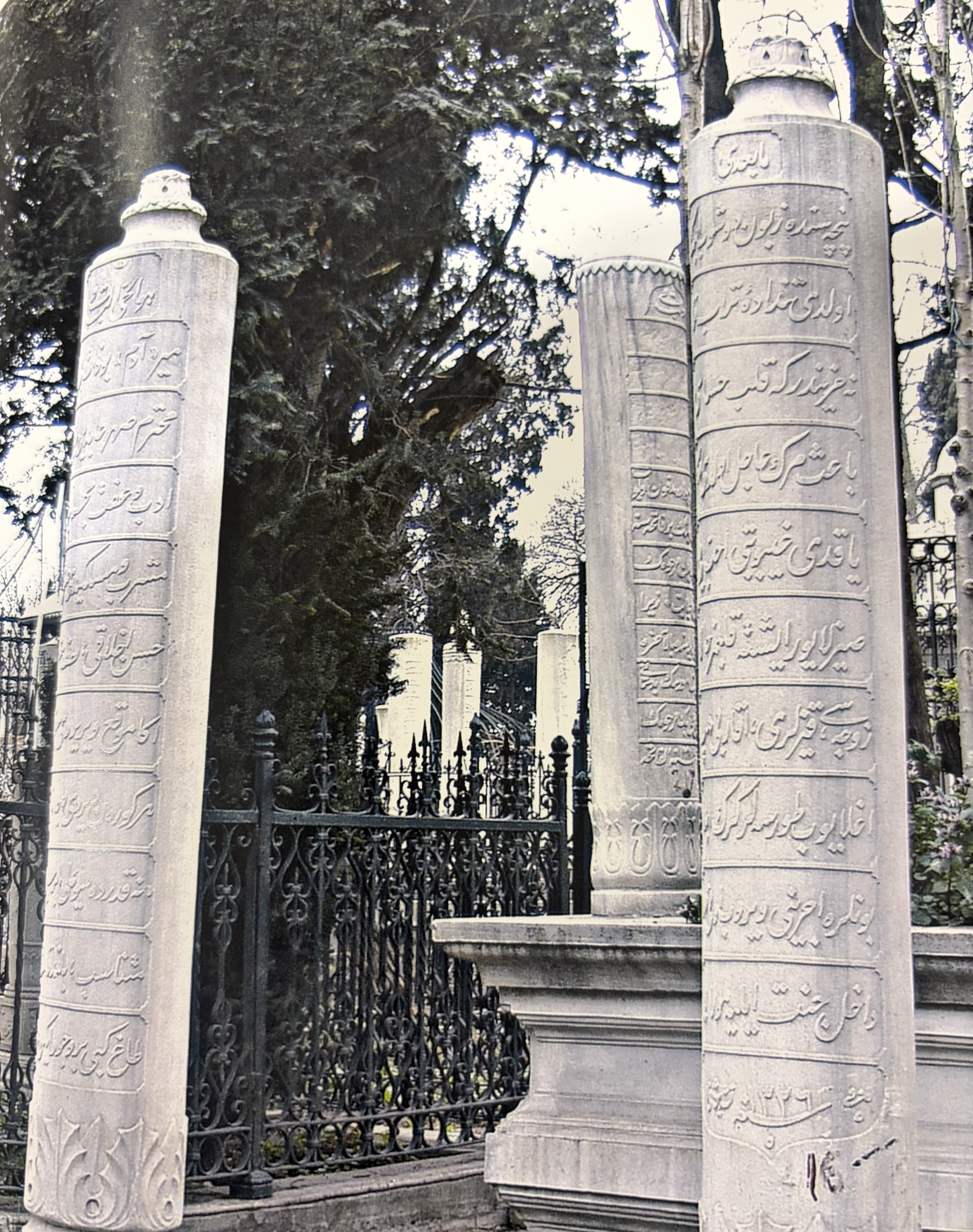
Âdem Bey died on 5 Teşrinisani 1326, corresponding to 18 November 1910, leaving behind his wife and daughters, and was buried in the Fatih Mosque Cemetery.
Epitaph
He is the Creator, the Eternal. This gentleman, this peerless person, was the respected brother-in-law of Âbidin Paşa. He was a monument of refinement and honor. Righteousness and loyalty were both his nature and his profession. His fine character, grace and manner gave him a distinguished place. Whoever saw his radiant, luminous face would say: "What a lovely countenance!" Although he was upright, tall and mountain-like in build, alas, in the hand of fate he became powerless and weak and surrendered his body to the soil of nonexistence. How sorrowful that his sensitive heart became the bird of death for him. His absence burned those who loved him. Our hearts still ache. May the Lord grant reward to his wife, daughters and relatives if they weep forever, and admit him too into His Paradise. 18 November 1910.
A Fatiha for his/her soul