
Ahmed Amiş Efendi
Profile summary
Highlights
Ahmed Amiş Efendi was born in Tırnova in 1807, completed his madrasa education there, and served as a primary school teacher. Among the students of this school, known in sources as “Amiş’s School,” were İsmail Fenni Ertuğrul, who would later become an important thinker, and the calligrapher Hasan Rızâ Efendi.
In his twenties he became attached to Ömer Halvetî, who belonged to the Kuşadaviyye branch of the Şabâniyye order. In 1846 he was authorized for spiritual guidance, and later went to Istanbul where he met Mehmed Tevfik Bosnevî, one of the deputies of Kuşadalı İbrahim Efendi. When he returned to Tırnova, he operated a bathhouse for a time; this choice was influenced by the lifestyle of Bosnevî Mehmed Tevfik Efendi, owner of the Çinili Hamam near Zeyrek.
After 1877 he left Tırnova. When he came to Istanbul, he took over the caretaking of the Tomb of Mehmed the Conqueror from Niğdeli Bekir Efendi and from then on became known as “Fatih Türbedarı.”
Ahmed Amiş Efendi’s Sufi path was the Halvetî-Şabânî chain. In addition, he received a Naqshbandi ijazah from Gümüşhâneli Ahmed Ziyâeddin Efendi; in 1886 he met Nûrü’l-Arabî in Skopje and received ijazah from him as well. Sources describe him as one of the greatest Melâmîs of his age after Nûrü’l-Arabî.
Amiş Efendi did not author books, but his conversations, sayings and some memories were recorded by those around him. Narrations transmitted from Abdülaziz Mecdi Tolun are preserved in Osman Ergin’s notebook Mecmûa-i Tasavvuf, and it is also recorded that Ahmed Avni Konuk kept notes from Amiş Efendi’s conversations.
Among his close associates and students were important figures of late Ottoman scholarly, intellectual and Sufi circles, including Bursalı Mehmed Tâhir, Babanzâde Ahmed Naim, Ahmed Avni Konuk, Hüseyin Avni Konukman, İsmail Fenni Ertuğrul, Abdülaziz Mecdi Tolun and Maraşlı Ahmed Tâhir Efendi. His daughter married Babanzâde Ahmed Naim Bey.
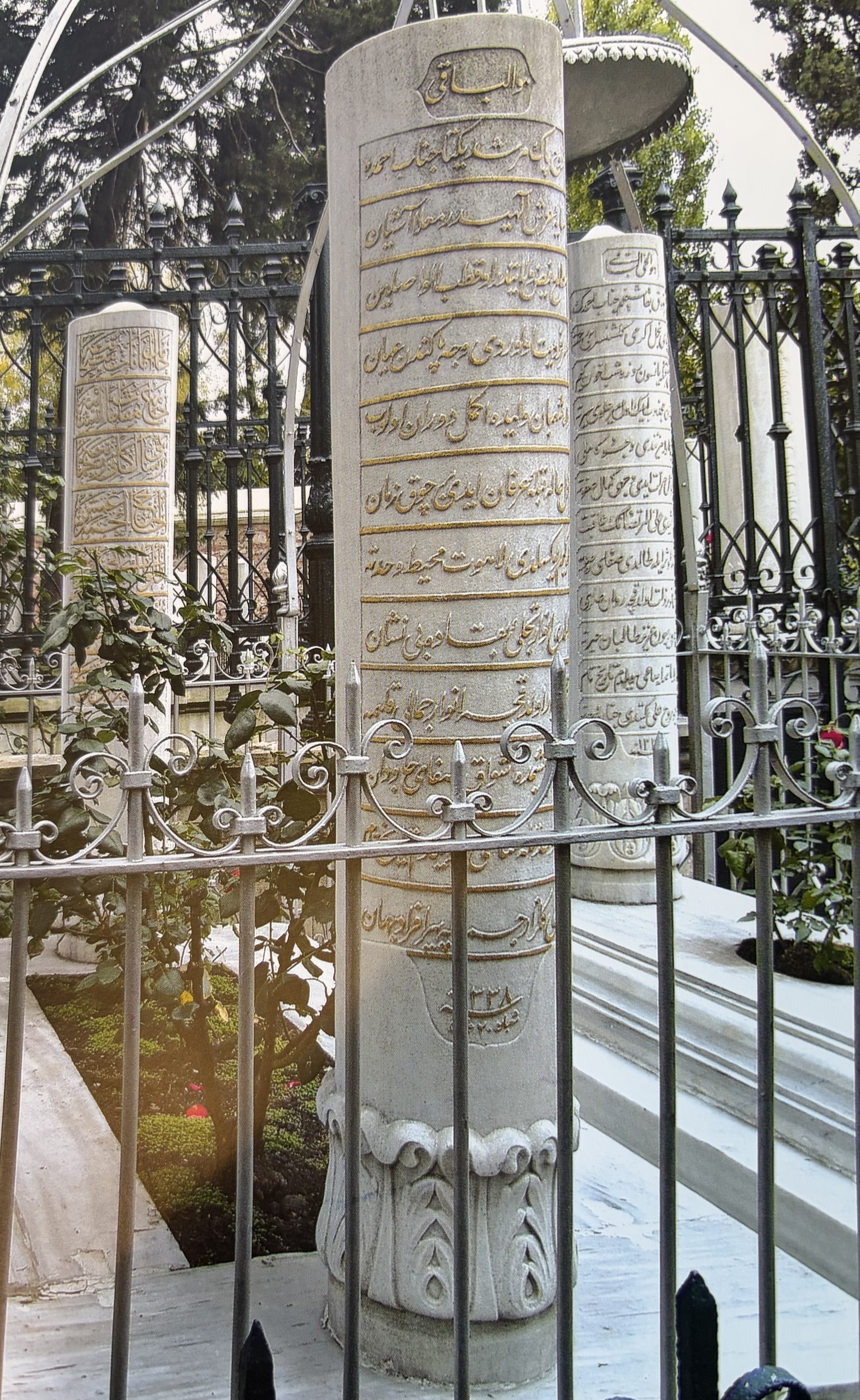
Ahmed Amiş Efendi died on 9 May 1920 at the Şehzadebaşı house of his son-in-law Babanzâde Ahmed Naim Bey. His body was washed by Bekir Efendi, imam of Fatih Mosque, and the funeral prayer was led by Abdülaziz Mecdi Efendi. Regarding Bekir Efendi’s washing of the body, it is related that years earlier, when he had wanted to help Ahmed Amiş Efendi at Sarıgüzel Bath, he had received from him the reply, “You will wash me thoroughly later.” Ahmed Amiş Efendi was buried near the Tomb of Mehmed the Conqueror, which he had served for many years, beside the grave of his son Ali Hâkî Bey.
The poem on Ahmed Amiş Efendi’s gravestone was composed by his disciple Evrenoszâde Sâmi Bey. The celî sülüs inscription at the head and the celî ta‘lik writing at the foot belong to Hatib Ömer Vasfî Efendi. Ömer Vasfî Efendi was trained under Sâmi Efendi and is known among late-period calligraphers for the gravestone of Ahmed Amiş Efendi, his celî sülüs panel in Hırka-i Şerîf Mosque and several grave inscriptions.
Epitaph
He is the Eternal. The exalted station worthy of the pure soul of the unique and peerless guide Hazrat Ahmed is the shadow of the divine Throne. He is the exalted one of those who reached Allah and the source of the grace of sainthood. The secret of unity was seen on his pure face. In the path of Şaban-ı Veli he was the most perfect of his age and for a long time the qibla of spiritual knowledge for people of state. Alas! He rose to the realm of divine unity and vanished within the lights of eternal manifestation. As the lights of his face spread joy into my heart, the excitements of immortality shine before me. With the attraction of unity, Sami spoke the complete chronogram: "The unique pir of the world went to the rose garden where he will behold the beauty of Allah." 9 May 1920. Written by the calligrapher Ömer Vasfi.
A Fatiha for the noble soul of Hacı Ahmed Amiş Hazretleri of the Şabaniyye branch of the Halvetiyye—may Allah sanctify his secret—who bore the trusts of Allah, gathered in himself the stations proper to humanity, and was a guide for those on the path of Allah.
A Fatiha for his/her soul