
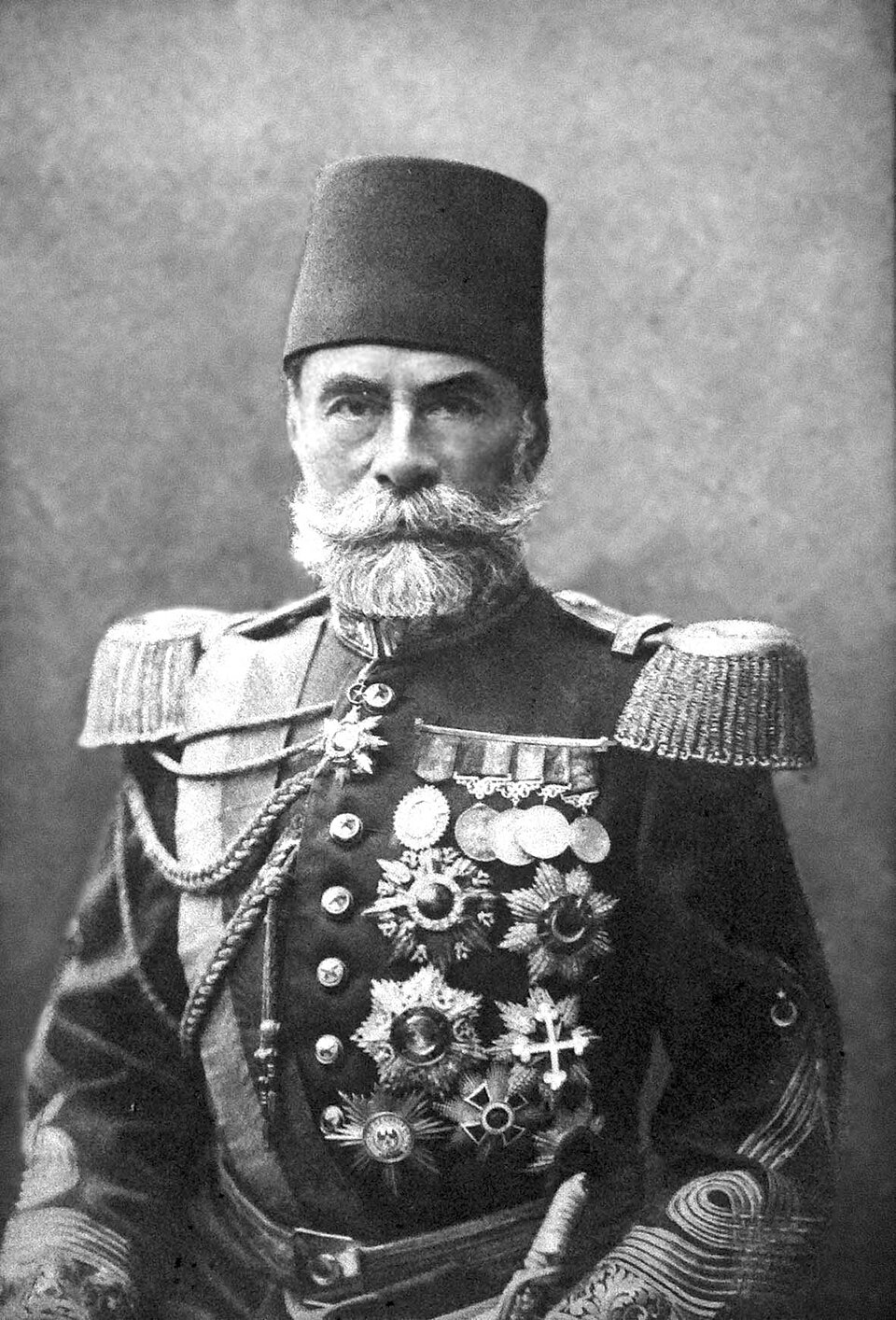
Gazi Ahmed Muhtar Paşa
Profile summary
Highlights
Ahmed Muhtar Paşa was born in Bursa in 1839 and was the son of Hacı Halil Ağa of the Katırcıoğlu family. After Bursa Military İdadi, he graduated first from the Military Academy in 1860 and became a staff captain one year later. He taught at the Academy, was appointed tutor to Şehzade Yusuf İzzeddin Efendi, and joined Sultan Abdülaziz’s European journey in his entourage.
He was among the founders of the Cem‘iyet-i Tedrîsiye-i İslâmiye, established in 1864. The first group of this society, which later prepared the ground for the foundation of Dârüşşafaka, included Yusuf Ziyâ Paşa, Gazi Ahmed Muhtar Paşa, Vidinli Tevfik Paşa, Sakızlı Ahmed Esad Paşa and Ali Nakî Efendi. Ahmed Muhtar Paşa was among those who personally taught at the society’s Valide School near Beyazıt.
In his military career he served across a wide area including Yemen, Crete, Bosnia-Herzegovina, the Montenegro frontier, Erzurum and Manastır. In Yemen he took Reyde and San‘a; during the process by which the region was reorganized as a province, he served as governor and commander. His promotion to marshal at the age of thirty-two is one of the most striking stages of his rapid rise in the Ottoman military hierarchy.
In the Ottoman-Russian War of 1877-1878, he achieved success against Russian forces and was rewarded by Abdülhamid II with the title “Gazi,” a sword, two horses and the Mecîdî order.
After the war he served as Chief of the General Staff. In 1885 he was appointed extraordinary commissioner to Egypt, represented the Ottoman Empire in the Egyptian question under British occupation, and remained in Egypt for about twenty-three years until the proclamation of the Second Constitutional Period.
After 1908 he returned to Istanbul, was appointed grand vizier in 1912, and formed a government known as the “Great Cabinet” because it included three former grand viziers, and as the “Father-Son Cabinet” because his son Mahmud Muhtar Paşa served as Minister of the Navy. During his grand vizierate, the Treaty of Ouchy ending the Tripolitanian War was signed; after the Balkan War began, he left office on 29 October 1912.
Gazi Ahmed Muhtar Paşa was known not only for soldiering and statesmanship but also for his studies in mathematics, astronomy and calendars. In his work Riyâzü’l-Muhtâr Mir’âtü’l-Mîkat ve’l-Edvâr, he dealt with the planisphere, astrolabe, measurement of time, determination of latitude and longitude, and calendar questions. His Islâhu’t-Takvîm was translated into French, and for this work he was awarded a special gold medal by the German state. His Takvîmü’s-Sinîn later became one of the main sources for Faik Reşit Unat’s guide to converting Hijri and Gregorian dates.
Gazi Ahmed Muhtar Paşa died on 21 January 1919 at his mansion in Feneryolu and was buried near the Tomb of Mehmed the Conqueror.
Epitaph
"In the name of Allah, the Most Gracious, the Most Merciful. Beware of a day when no one will be able to pay anything on behalf of another to escape punishment." (Bakara 48) For the sake of Allah, a Fatiha for the soul of Marshal Gazi Ahmed Muhtar Paşa, born in Bursa in Hijri 1255 / 1839, son of Halil İbrahim, son of İbrahim Edhem, one of the senators and former prime ministers. Tuesday, 22 January 1918.
A Fatiha for his/her soul