
Mehmed Es'ad Yesari Efendi
Profile summary
Highlights
Mehmed Es‘ad Yesârî Efendi was born in Istanbul in the mid-1730s as the son of Kara Mahmud Ağa, one of the court bailiffs of the Anatolian Kazasker sharia court. Although the right side of his body was paralysed from birth and his left hand was also impaired, he developed a deep passion for ta‘lik calligraphy. The nickname “Yesârî” was given to him because he wrote with his left side.
He first applied to Şeyhülislâm Veliyyüddin Efendi, one of the great calligraphers of the period, but was not accepted as a student because of his physical disability. He later practised under Dedezâde Mehmed Said Efendi and received his ijazah in ta‘lik in 1754. The presence of Veliyyüddin Efendi at this ijazah ceremony is a striking detail showing the artistic power Yesârî had reached in a short time.
Mehmed Es‘ad Yesârî initially followed the style of Mîr İmâd, the great master of Persian ta‘lik, but over time reshaped this script according to Ottoman taste. From 1776 onward he pioneered the emergence of a distinct Turkish ta‘lik style, and especially after the 1780s produced some of its strongest examples. In Ottoman calligraphy he is remembered not merely as a successful calligrapher, but as the founder of a school.
He also enjoyed great prestige in the palace circle and was appointed calligraphy teacher at the Imperial Palace by Sultan Mustafa III. During the reigns of Abdülhamid I and Selim III, he was commissioned to write many monumental celî ta‘lik inscriptions for mosques, tombs, fountains, madrasas, libraries, palaces and commemorative stones. Among his important works in Istanbul are the Beylerbeyi Mosque, the Emirgân Mosque and Fountain, the Hacı Selim Ağa Library, the inner entrance inscription of the Tomb of Mehmed the Conqueror, the inscriptions of Aynalıkavak Pavilion and the Eyüp Mihrişah Vâlide Sultan Imaret.
Yesârî Efendi’s house also functioned like a calligraphy school. Besides his son, his students included Mîr Mehmed Emin, Arapzâde Mehmed Sâdullah, Mehmed Şehâbeddin, Mektûbî İbrâhim Edhem and Şerif İhyâ Efendi. His greatest follower was his son Yesârîzâde Mustafa İzzet Efendi, who carried the ta‘lik line he inherited from his father to the summit of celî ta‘lik in the nineteenth century.
Mehmed Es‘ad Yesârî Efendi died on 12 Rajab 1213, corresponding to 20 December 1798, and was buried in the cemetery of the Tûtî Abdüllatif Efendi Madrasa in the Gelenbevî quarter of Fatih. His son Yesârîzâde Mustafa İzzet Efendi, who died in 1849, was buried beside him.
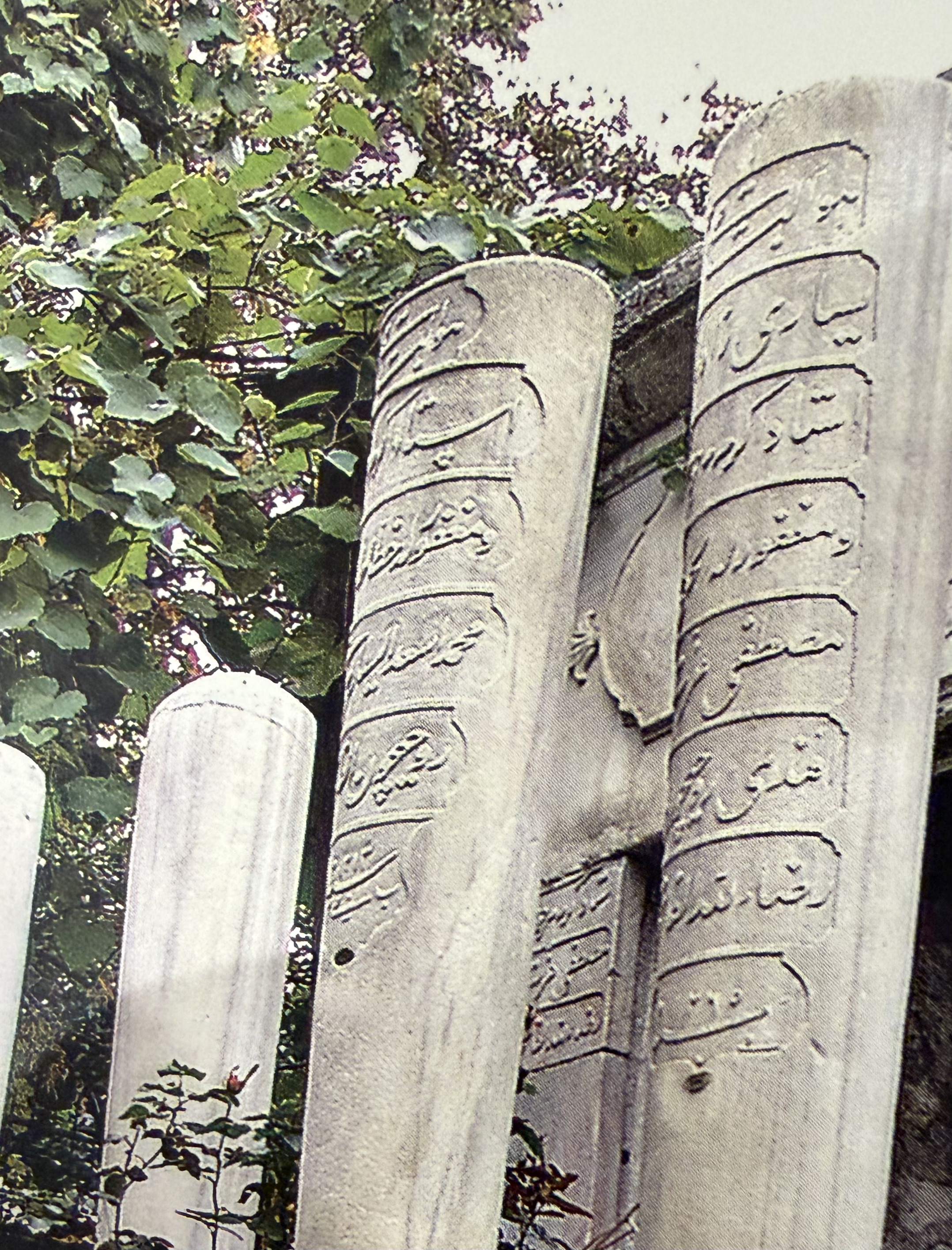
This small cemetery disappeared during the fires and road-widening works of the early twentieth century, and the gravestones of the two great calligraphers were later brought to the Fatih Mosque Cemetery. The gravestone seen today in the Fatih Mosque Cemetery carries the memory of this lost cemetery and of two major names in Ottoman ta‘lik calligraphy.
Epitaph
"Every soul shall taste death." (Ankabut 57) A Fatiha for the souls of Tûtî Abdüllatîf and the greatest master, Calligrapher Hacı Mehmed Esad Yesârî Efendi, who attained Allah’s mercy and forgiveness.
He is the Eternal. A Fatiha for the soul of Calligrapher Hacı Mehmed Esad Yesârî Efendi, the greatest master, who attained Allah’s mercy and forgiveness. 20 December 1798.
A Fatiha for his/her soul