
Mehmed Emin Efendi
Profile summary
Highlights
Born in 1815 in Ballıca village of the Of district of Trabzon, Mehmed Emin Efendi went to Erzurum at a young age for scholarly training. After studying there for several years, he came to Istanbul in 1838 and studied with teachers such as Saçlı Ahmed Efendi and Toyranlı Mehmed Efendi.
After receiving his ijazah, he taught creed, Qur’anic commentary and Islamic law for many years at Fatih Mosque, becoming especially known for the sermons he delivered on Fridays. Mehmed Emin Efendi, who lived near the Hırka-i Şerif Mosque, was also known in his circle as “Sütçü Mehmed Efendi,” because he made his living through animal husbandry.
Alongside his preaching and guidance activities, he wrote Mecâlis-i İrşâdiyye, Necâtü’l-Mü’minîn and many other treatises. His most famous work, Necâtü’l-Mü’minîn, aimed especially to correct mistakes commonly seen among the public in prayer and worship, and became one of the important catechism books of its period.
Mehmed Emin Efendi’s harsh style attracted attention from time to time. Because of his treatise on smoking, an investigation was opened against him; around a thousand copies of his treatises found in his house in Hırka-i Şerif were confiscated, and he was exiled to Kütahya for two years.
Over time, a religious circle known as the “Fatih Sofuları” formed around Mehmed Emin Efendi. Sources state that this circle gathered especially in and around Fatih Mosque and was also distinguished by its daily practices and clothing.
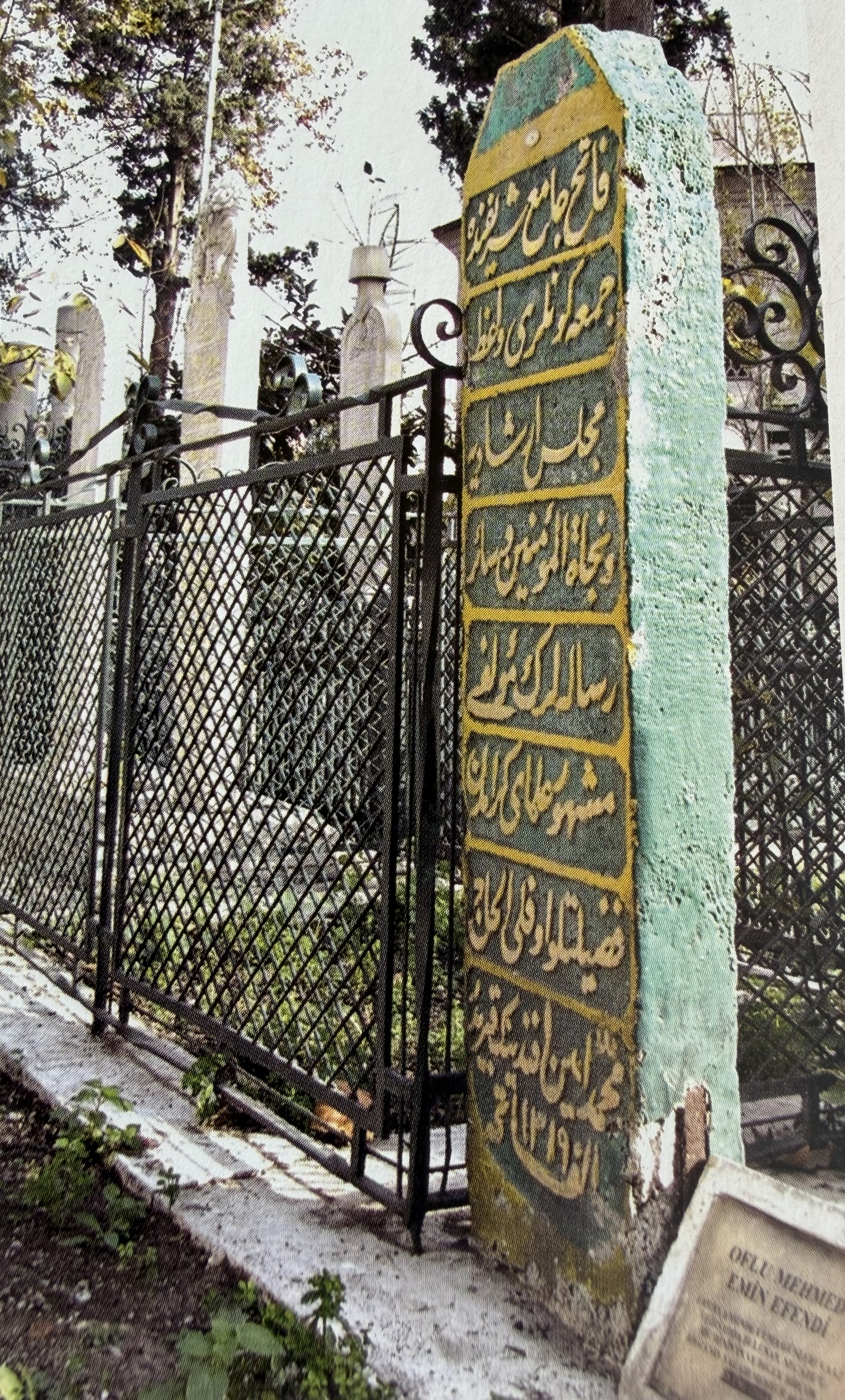
Mehmed Emin Efendi died in 1319 (1901) and was buried in the Fatih Mosque Cemetery.
Epitaph
This is the grave of the virtuous Oflu Hacı Mehmed Emin Efendi, one of the famous religious scholars, who preached on Fridays at Fatih Mosque and wrote works such as Meclis-i İrşadiye and Necatü’l-Müminin. Fatiha. 1901.
A Fatiha for his/her soul