
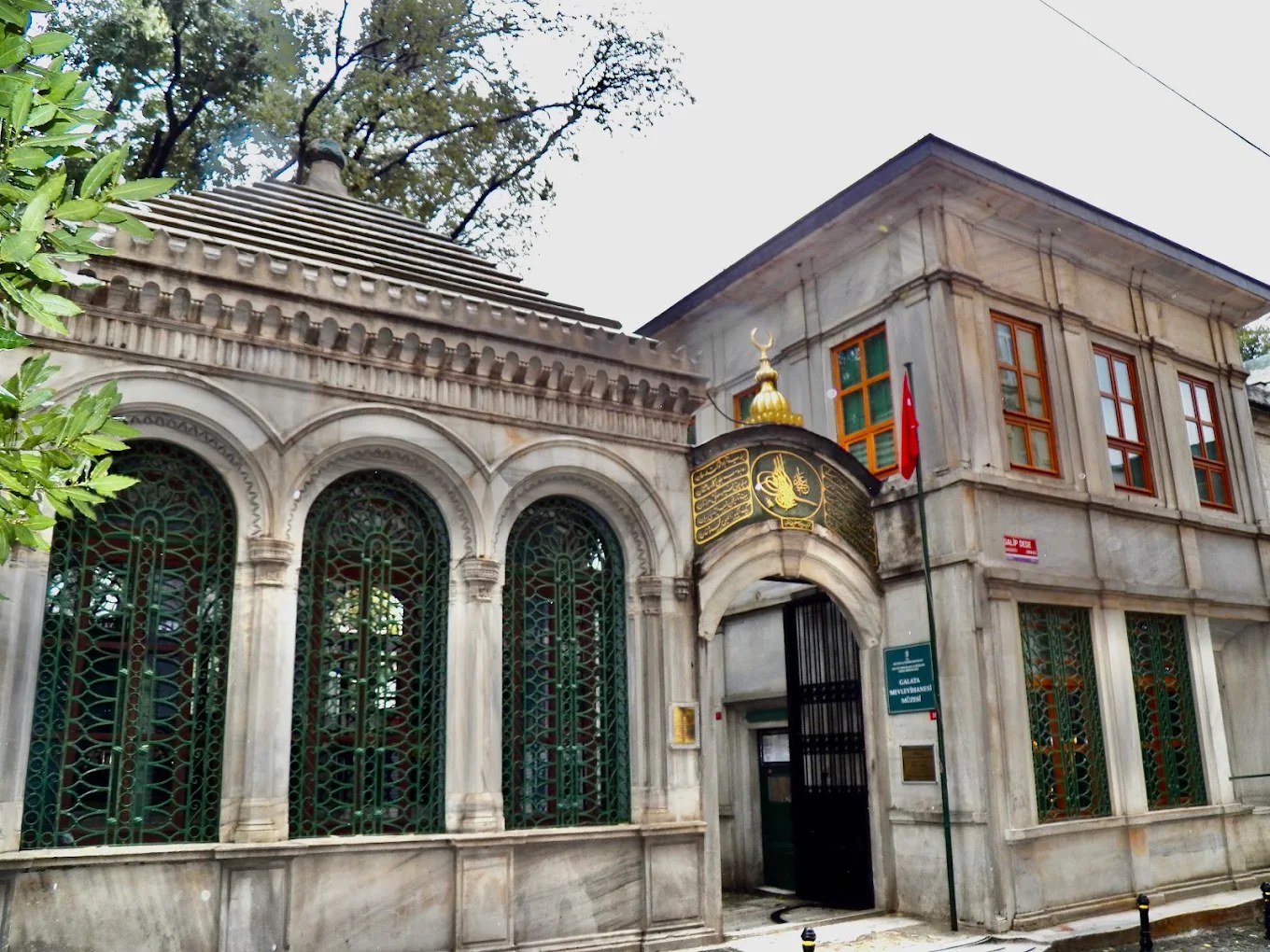
Changes After Construction
The historic structure was commissioned in 1491 by İskender Pasha, one of the statesmen of the Bayezid II period.
The Mevlevi lodge was damaged in the Great Istanbul Earthquake of 1509 and, after remaining without patronage for some time, fell into ruin.
According to official records, the earliest known repair work was carried out by Matbah Emini İsmail Efendi, as indicated by an Ottoman restoration inscription dated 1651.
It was devastated in the Great Tophane Fire of 1765 and was rebuilt within the same year by Yenişehirli Osman Efendi upon the order of Sultan Mustafa III.
During the reign of Sultan Mahmud II, it underwent two major repairs, in 1819 and 1835.
It acquired its present form through the reconstruction works carried out during the reign of Sultan Abdülmecid between 1851 and 1859.
In the 20th century, the building was also used as a community center, a police station, and for a time as the Museum of Divan Literature. Today, it serves as the Galata Mevlevi Lodge and Museum under the Ministry of Culture and Tourism.
Featured Highlights
The building is also known as the “Kulekapı Mevlevi Lodge.”
It has the distinction of being the first principal Mevlevi lodge, or asitane, in Istanbul.
Today, the Mevlevi lodge complex includes a sema hall, dervish rooms, a library, a sebil and fountains, tombs, an ablution fountain, and a laundry building.
The Halet Efendi Library, which houses more than 800 valuable manuscripts, is also located within the complex.
The tombs of Şeyh Galip, a poet of Turkish Divan literature, and Halet Efendi, a statesman of the reign of Sultan Mahmud II, are located in the garden.
Divani Mehmed Dede, also known as Divani Mehmed Çelebi, who descended from Mevlana Jalal al-Din Rumi and is regarded as the second founder of the Mevlevi order, became the first sheikh of the Galata Mevlevi Lodge.
Sultan Selim III and Sultan Mahmud II went down in history as two sultans who took a close interest in the Galata Mevlevi Lodge.
The ablution fountain commissioned by Adile Sultan, daughter of Sultan Mahmud II, is also open to visitors within the complex.
At the entrance of the octagonal sema hall is the repair inscription of Sultan Abdülmecid, dated 1853.