
Changes After Construction
According to the historical inscription of the külliye in which it is located, the mosque was built in 1745. The same inscription states that the külliye was constructed on the site of an older mosque.
The structure, recorded as “Ağa Mosque,” was repaired by Sultan Mahmud II between 1826 and 1839.
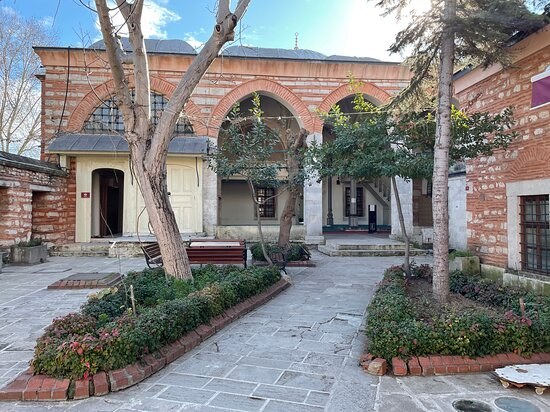
In 1986, the courtyard section of the mosque was completely altered, and an underground ablution fountain and toilets, not in keeping with the layout and architecture of the külliye, were built.
The mosque and the külliye of which it forms part acquired their present form after an extensive restoration in 2010.
Featured Highlights
It has a square-planned interior prayer hall and a lead-covered dome set on a polygonal base. Since it was built on sloping ground, there are shops and a sebil on its lower level.
It has three porticoes and four domes, as well as elevated pointed arches rarely seen in Ottoman architecture.
The gallery, resting on marble columns, has wooden flooring; to its east is the sultan’s gallery. The pulpit is wooden, while the mihrab is decorated with painted ornamentation.
The books once held in the mosque’s library were transferred to the Süleymaniye Library.
The sebil belonging to this structure, which reflects the Baroque style in an outstanding way, is made of marble and has broad wooden eaves. Its windows are designed with inward curves.
On the entrance gate of the mosque is the original tughra of Sultan Mahmud II.
Hacı Beşir Ağa, who administered the Ottoman imperial harem continuously for 30 years between 1717 and 1746, became one of the most powerful and influential figures of the palace.