Changes After Construction
According to records from the Ottoman period, it was repaired in 1743.
It was restored in 1938 after the proclamation of the Republic.
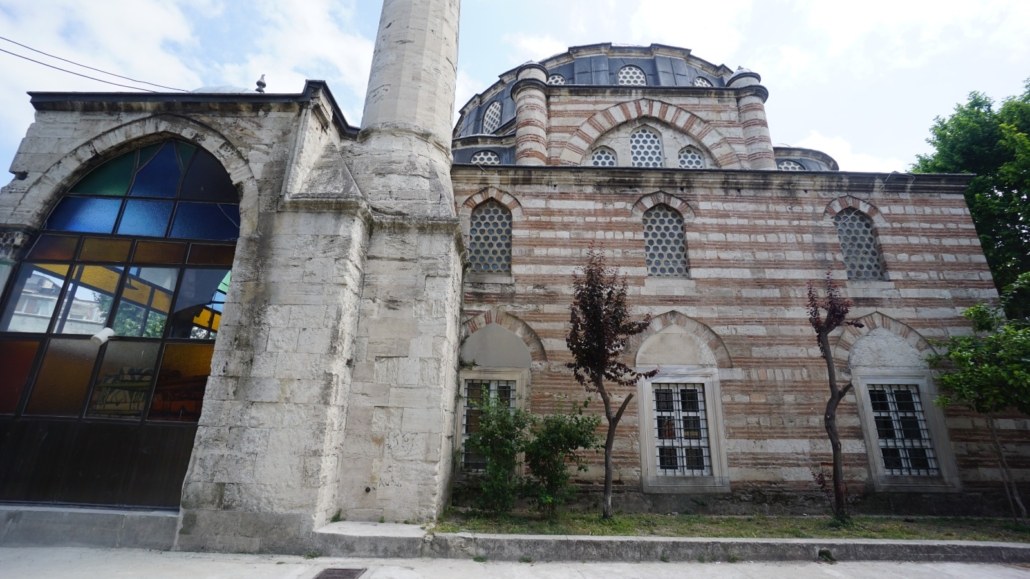
In the 1980s, the narthex was covered with glass.
Some of the columns in the narthex of the mosque, which was repaired by the Foundations Administration in 1982, were replaced and the cracked columns were reinforced with iron rings.
Its library was transferred to the Sultan Selim Library in 1914, to the Murad Molla Library in 1920, and to the Süleymaniye Library in 1949.
Featured Highlights
The mihrab has a protruding square plan and the narthex has five units. The harim is covered with a single dome on eight wall piers (feet, supports). In the harim, the piers on the mihrab axis are square-sectioned, the others are piers with muqarnas (stalactite) capitals and cylindrical bodies. The dome is supported by eight weight towers.
It has a single minaret with a polygonal sectioned body on a rectangular base and a muqarnas balcony. It can be exited from both the harim and the narthex.
The mosque features 16th century İznik and Kütahya tiles and 18th century Tekfur Palace tiles. There are inscribed tile panels and hand-drawn decorations on the walls.
The narthex has a pointed arch , six marble columns with muqarnas (stalactites) and five units. It has marble mihrab niches and two small mihrabs.
The double bathhouse located in the northwest of the building has a square plan and squinched domed dressing rooms. It has a construction inscription dated 1586.
The madrasah of the building According to the foundation charter, it was built as a ten-room darülhadis (a place where hadith was taught); it was damaged in the 1894 earthquake and later disappeared.
The mosque and the lodge were designed as a whole. Until the mid-19th century, it changed hands between the Halveti and Bayrami orders, and for a short time it was affiliated with the Qadiriyya and finally with the Sunbulî branch of the Halveti order. It was renovated by Abdulhamid II in 1894.
There are two fountains with pointed arches in the classical style at the east and west courtyard gates. One has been restored, the other is in disrepair.