
Changes After Construction
In the 1961 repair, the access/approach arrangement of the madrasa was reworked, and an entrance scheme was formed in which the classroom section is reached by stairs.
In the 1961 repair, some changes were made to the interior arrangement, and the madrasa courtyard was covered.
In the Republican period, it was used for a long time as a Children’s Dispensary and a Mental Health building.
Today it is used as a private medical/health center.
Featured Highlights
It is also known as the Kurşunlu Madrasa; it is stated that its domes were covered with lead.
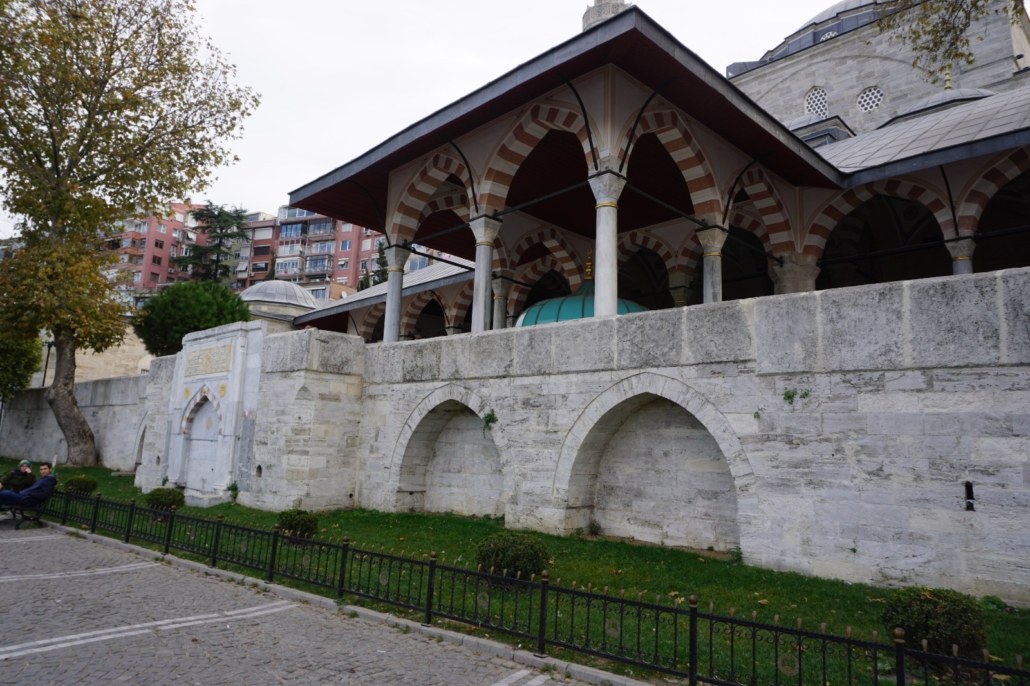
It is located to the north of the Mihrimah Sultan Mosque; the rectangular courtyard is entered through a monumental gate opening from the mosque courtyard, and it is noted that there was a marble fountain at the center of the courtyard.
The cells are defined as a total of sixteen, with seven on each of the two long sides of the porticoed courtyard and one on each side of the classroom.
It is recorded that the rooms had three windows each, as well as fireplace and cupboard niches; in front of the gate, the rooms, and the classroom, there was a domed portico carried by marble columns, whose capitals are described as diamond-shaped.
The square-planned classroom is described as having a single blind dome; it is stated that there were small supporting domes at the corners and that the classroom was lit by windows.
It is stated that the madrasa stands on a terrace and that the facade on the sea side was reinforced with stone buttresses.
In the conditions of the endowment, daily akçe allocations were assigned for the mudarris and the students; it is recorded that the madrasa’s first mudarris, Imamzade Mehmet Efendi, was appointed in 1547–1548.