Person in the Tomb
Nureddin Cerrahi was born in Istanbul in either 1660/61 or 1672. His father, Abdullah Ağa, served in the Ottoman palace. He received his early education in Cerrahpaşa, studied calligraphy, and continued at the Süleymaniye Madrasa.
He benefited from the poet Nabi in literary matters. Though appointed as a judge in Egypt in 1689 or 1696, he declined the position after meeting the Halveti sheikh Köstendilli Ali Alaeddin Efendi through his uncle and became his disciple.
He attended the Üsküdar lodge for seven years and became a halife (authorized spiritual successor) in 1703. That same year, by order of Sultan Ahmed III, a lodge was established for him in Karagümrük, where he continued guiding disciples for 18 years. He passed away on 1 October 1721 and was buried at the lodge.
His spiritual lineage is connected to the Halvetiyye-Ramazaniyye order. While some claim his coming was foretold, this remains disputed. He spread the Cerrahi order through seven main successors. He authored a treatise titled Mürşid-i Dervîşan, a collection of litanies (evrad), and a short poem.
About the Mausoleum
- Year Built
- Commissioned By
- Architect
- Location
Featured Highlights
This space, uniting the semahane and tomb under one roof, is one of the earliest and most distinguished examples of the “interwoven semahane-tomb” layout in Sufi architecture.
It has a rectangular plan measuring 18.5 × 6.5 meters along the north-south axis. The tomb section is elegantly separated from the whirling area by carved walnut posts and pierced wooden balustrades in the kündekârî technique.
Inside are about thirty sandukas, including that of the pir, Nureddin Cerrahi, whose elevated cenotaph is adorned with gold-gilded wrought iron railing, baroque vine-scroll decorations, and crystal chandeliers for emphasis.
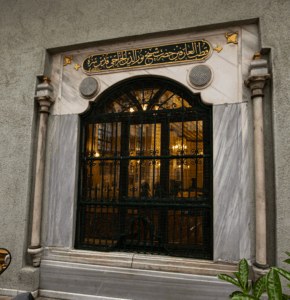
A projecting niyaz penceresi (supplication window) on the southern wall allows visitors to direct their prayers toward the cenotaph without entering. The northern wall features a “small tomb” added in the 19th century and a “cennet oda” (heavenly room) preserving relics, enhancing the sanctity of the space.
Kütahya tiles with chain-like zencerek borders surround the mihrab niche; a band of celî sülüs script runs along the upper interior, and delicate wood carvings on the balconies merge with the refined column capitals of the portico-passage system to create a space of both aesthetic and spiritual harmony.