
Changes After Construction
The historical roots of the structure trace back first to a monastery of Greek Orthodox origin in the early 13th century, and later to the Pera Cistern Monastery (Santa Maria della Cisterna), associated with a bell tower built by the Genoese in 1362.
In 1450, the complex consisting of the bell tower and church came under the protection of French Benedictine monks led by Dom Nicolas Meynet and continued to function as a monastery dedicated to Saint Benedict.
The first use of the complex for educational purposes occurred in 1583 through the initiative of Jesuit priests.
Used as a monastery, school, and hospital by the Jesuits, the complex was transferred to the Lazarist priests in 1783, a date accepted as the official foundation of the present high school.
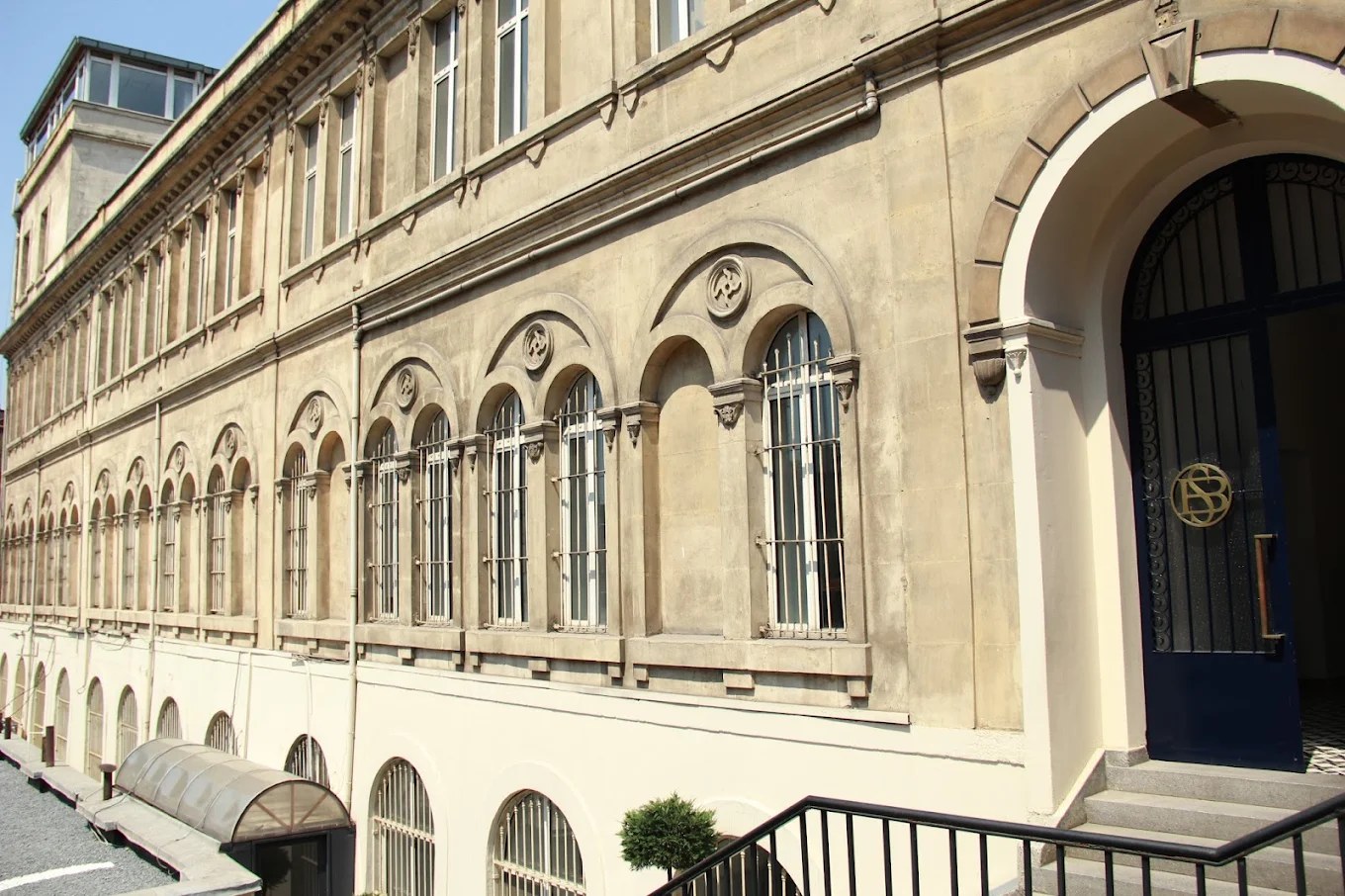
The school buildings, which had deteriorated over time, were completely demolished in 1875 and rebuilt in their present form by architect Alphonse Cingria, a graduate of Saint Benoît.
During the First World War, the structure was converted into a 400-bed military hospital and has continued to be used for educational purposes since 1919.
In the 2000s, the complex underwent extensive repair and restoration works, taking on its present form.
Featured Highlights
Saint Benoît is the oldest Western educational institution in Turkey outside the later Westernized imperial-period schools and is also one of the most established Latin Catholic institutions in Istanbul.
In 1686, the church within the complex burned down; through the initiative of French Ambassador Pierre de Girardin, permission was granted for it to be rebuilt with a dome, a privilege that had previously been reserved only for mosques.
Initially admitting only students of French nationality, the school began to accept Ottoman subjects as well following a decree issued by Sultan Mahmud II in 1831.
Influenced by the fear caused by the 1894 Istanbul earthquake, the school’s science teacher, Father Jean Guérovitch, installed a seismograph at the school.
Saint Benoît High School became the first place in Turkey where meteorological measurements were carried out using scientific methods.
The bell tower that survives today was built by the Genoese in 1362.